FIFA World Cup: Up to 83% increase in speeding events after England’s World Cup games worthy of a red card!
London, 9th July 2026: Analysis of driving behaviour before, during and after each of England's matches at the FIFA World Cup shows a consistent and predictable pattern. Roads empty while the game is on, then fill rapidly – and dangerously - once the final whistle blows. With England facing its quarter-final vs Norway on Saturday 11th July, ThingCo is urging insurers to treat match days as foreseeable, time-boxed risk events for which they could implement intervention strategies to reduce loss ratios – and keep road users safe.
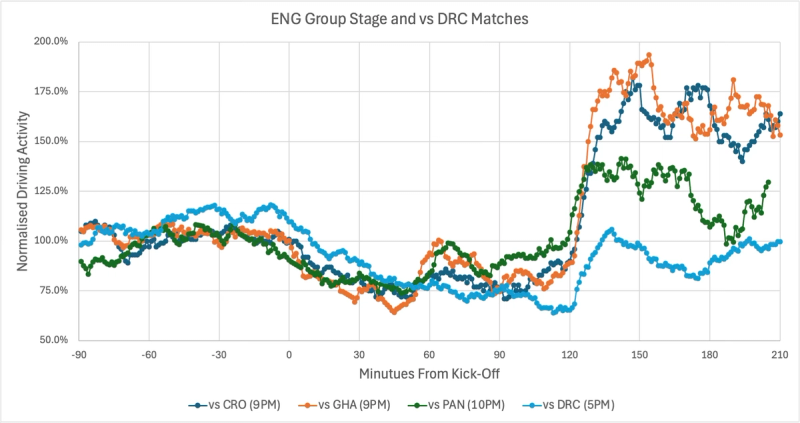
Across England's three group stage fixtures, against Croatia, Ghana and Panama, traffic volumes peaked between 41% and 93% above normal levels around two to two-and-a-half hours after kick-off as supporters left pubs, fan zones and friends' houses at broadly the same moment.
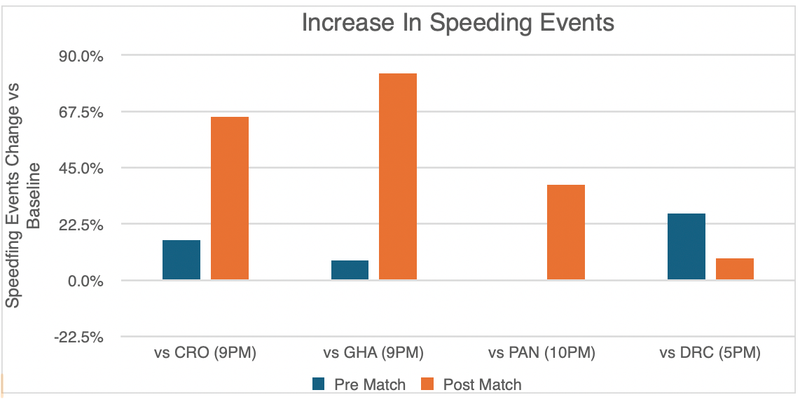
Speeding events over the same post-match window rose by 65% after the Croatia game, 83% after Ghana and 38% after Panama. Crucially, the increase was not simply a function of busier roads. Adjusted for distance driven, speeding per mile was up as much as 22% after the group games; drivers on the road were speeding more, not just that there were more of them.
The data also reveals a distinct risk profile for earlier kick-offs. Ahead of England's first knock-out match against DR Congo, which took place midweek at 5pm, speeding events rose 27% in the run-up to the match, as fans raced to get home in time for kick-off.
Dr Carlo Conner-Hill, Head of Data Analytics at ThingCo said: "What this data shows is that match-day risk is remarkably predictable. We can see almost to the minute when the roads will surge and when speeding will spike: it's the hour or two after the final whistle, and, for teatime kick-offs, the dash home before it.
“That predictability is a gift for insurers. Ahead of Saturday's quarter-final, a well-timed nudge - a push notification reminding customers to plan their journey home, leave the car at the pub, or simply watch their speed - costs almost nothing to deliver. Set against the claims cost of a single serious accident, the case for intervention is clear. Telematics gives insurers the ability to engage customers at exactly the moment risk is elevated which is good for road safety and good for loss ratios."
Speeding Events